· ReadyStack
Worked example
Real numbers from this tool, line by line.
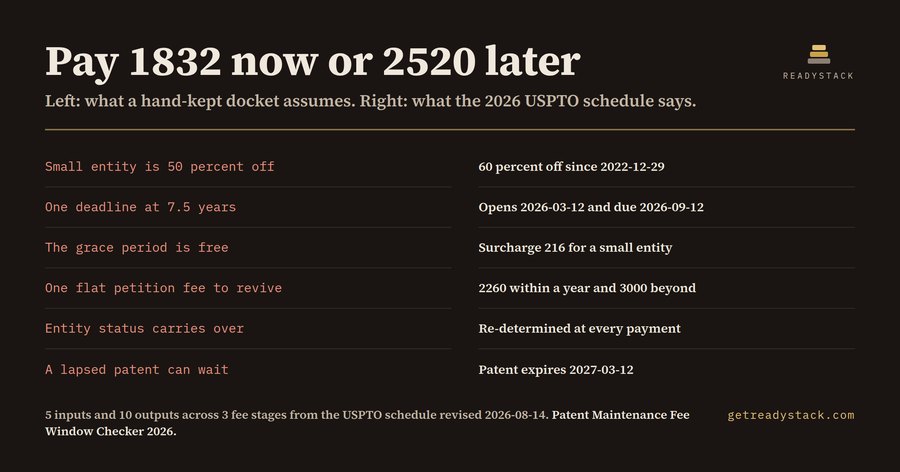
A US patent granted on 2019-03-12 and checked on 2026-09-22 as a small entity is already ten days past its no-surcharge date: 1832 is payable by 2027-03-12, and 2520 after that. Solo inventors and small-firm IP paralegals in the United States usually meet that second number in an expiration notice rather than in a calendar.
Here is why the calendar is hard to keep by hand. A US utility patent carries three maintenance fees, due at 3.5, 7.5 and 11.5 years from the grant date. Not the filing date. Each fee has a six-month window that opens early, then the due date, then a six-month grace period that costs a surcharge, and at the end of the grace period the patent is simply expired.
The amounts move too. Working from the USPTO fee schedule effective 2025-01-19 and last revised 2026-08-14, the large-entity maintenance fees are 2150 at 3.5 years, 4040 at 7.5 years and 8280 at 11.5 years. A small entity pays 60 percent less. A micro entity pays 80 percent less. That gives 860, 1616 and 3312 for a small entity and 430, 808 and 1656 for a micro entity.
The 60 percent figure is where most answers go wrong. The small-entity discount was 50 percent for decades and became 60 percent on 2022-12-29. Ask a language model what a small entity owes at 7.5 years and there is a good chance it answers 2020, which is half of 4040 and no longer a fee the USPTO charges. An answer that is off by a fifth is worse than no answer, because it looks right.
The grace period is the second trap. It is not free. A large entity pays a 540 surcharge to pay inside it, a small entity 216, a micro entity 108. That is the cheap outcome. The expensive one is the end of the grace window, after which only a petition under 37 CFR 1.378 brings the patent back, carrying the maintenance fee plus a petition fee under 37 CFR 1.17(m). That petition fee has two tiers: 2260 when the delay is one year or less and 3000 when it is longer, discounted to 40 percent for small entities. So the small-entity 7.5-year fee that costs 1616 inside the window costs 1832 in grace and 2520 once the patent has expired.
The third trap is entity status. Under 37 CFR 1.27(g) it is not a label the patent keeps; it has to be established afresh at every maintenance fee payment. A company that grew past the threshold or licensed the patent to a large entity owes the undiscounted amount. The same 2019-03-12 patent that owes 1832 in grace as a small entity owes 4580 at large-entity rates, and its revival cost goes from 2520 to 6300.
The extension is a browser popup and a single web page sharing one calculation. Five inputs: grant date, the date you check from, the entity status you will claim, a checkbox for whether that status changed, and how many patents sit at the same stage. Ten outputs: the stage in play, three dates, days remaining, three amounts, the docket total, and one sentence saying where you stand.
Change one input and the whole answer moves. A patent granted 2023-05-09, checked as a micro entity, is at the 3.5-year stage with 430 due by 2026-11-09 and 48 days left. A patent granted 2014-01-14 held by a large entity is already past its 11.5-year grace end of 2026-01-14: expired, and 10540 to petition it back.
Everything above is free, with no key, no cap and no watermark. The 60 dollar key does a different job on a different axis: it exports the whole docket as a dated CSV you keep, and sets browser alarms at 90, 30 and 7 days before each window closes. Nothing you type leaves the browser.
Questions people ask
What does the Patent Maintenance Fee Window Checker actually do?
You give it a US utility patent grant date, the date you are checking from, the entity status you will claim, whether that status changed, and how many patents sit at the same stage. Five inputs produce ten outputs: the stage in play, three dates, days remaining, three dollar figures, a docket total, and a plain sentence saying where you stand.
Who is this for?
US solo inventors and startup founders who pay their own maintenance fees, and paralegals at small IP firms who docket them in a spreadsheet. It is built for people without an annuity service, who learn the window closed only when the USPTO notice of expiration arrives months later.
Why is a chatbot or a free date calculator not enough here?
Language models still quote the pre-2022 fifty percent small-entity discount instead of sixty percent, and a single flat petition fee instead of the two tiers. A generic date calculator has no fee table at all. This checker carries the schedule effective 2025-01-19 and revised 2026-08-14.
What is free and what does the key unlock?
Every calculation is free and unlimited: all three stages, all 2026 amounts, the grace surcharge, and the revival cost. Nothing is blurred or capped. The twenty-nine dollar key adds two different things: a CSV export of the whole docket that you keep, and browser alarms at ninety, thirty and seven days.
What does getting this wrong cost?
Inside the six-month grace window a large entity pays a 540 surcharge. After that the patent is expired and only a 37 CFR 1.378 petition revives it, at 2260 when the delay is one year or less and 3000 when it is longer, on top of the fee itself. Small and micro entities pay those at 40 and 20 percent.
Ask about this tool
One question, answered by the person who built it. Your email only if you want the answer sent.